


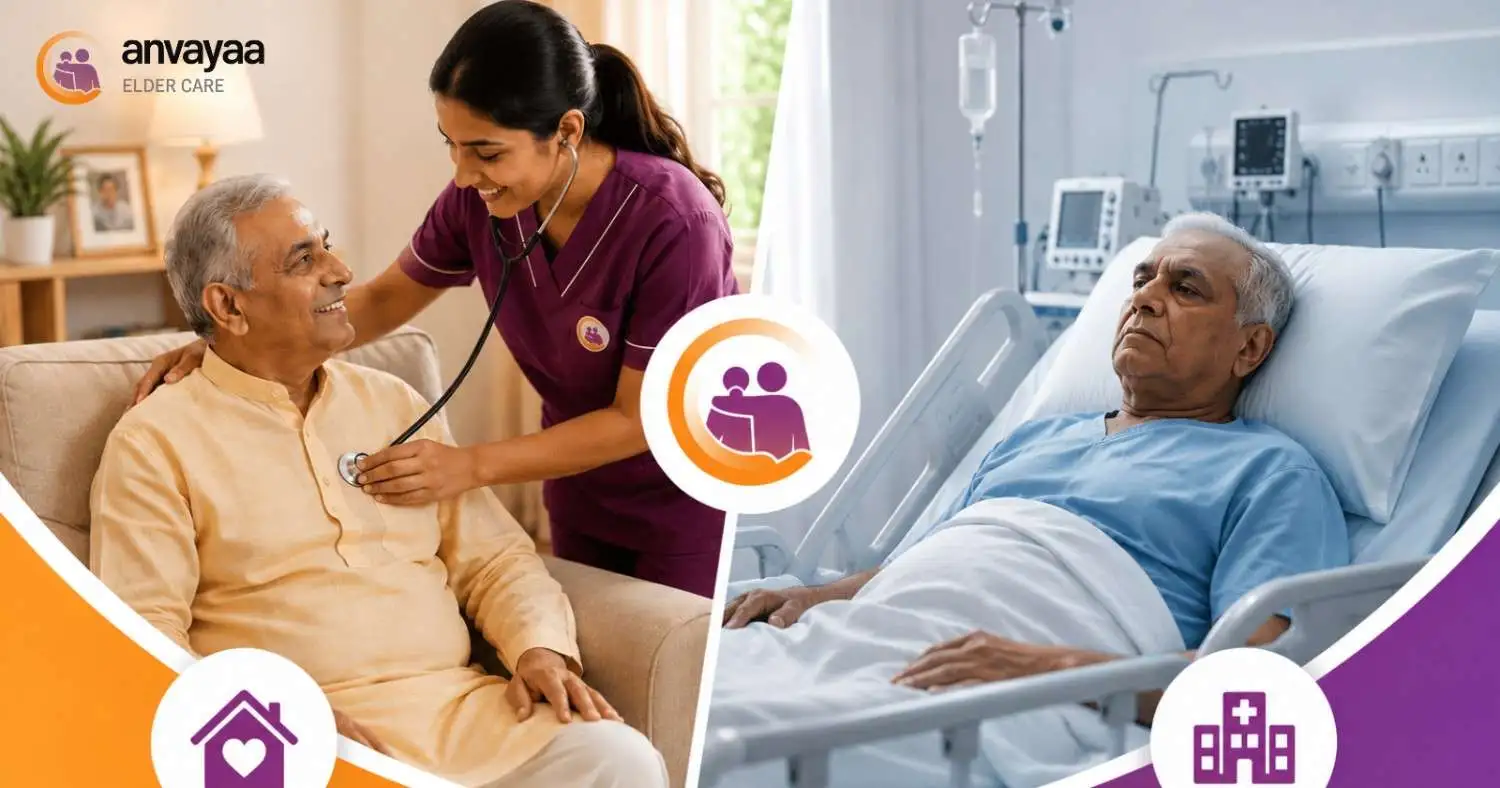
As our parents and grandparents grow older, families are often faced with a difficult question: when a senior needs medical attention, recovery support, or ongoing care, is it better to keep them at home with a trained nurse, or admit them to a hospital? There’s no one-size-fits-all answer, but understanding the differences between home nursing care and hospital care can help families make the right choice for their loved ones.
In this blog, we’ll break down what each option involves, compare their benefits and limitations, and look at how a comfortable, familiar environment can make a real difference in a senior’s recovery and overall wellbeing. We’ll also explore how Anvayaa is helping thousands of families across India bring high-quality nursing care into the comfort of their own homes.
Understanding Hospital Care
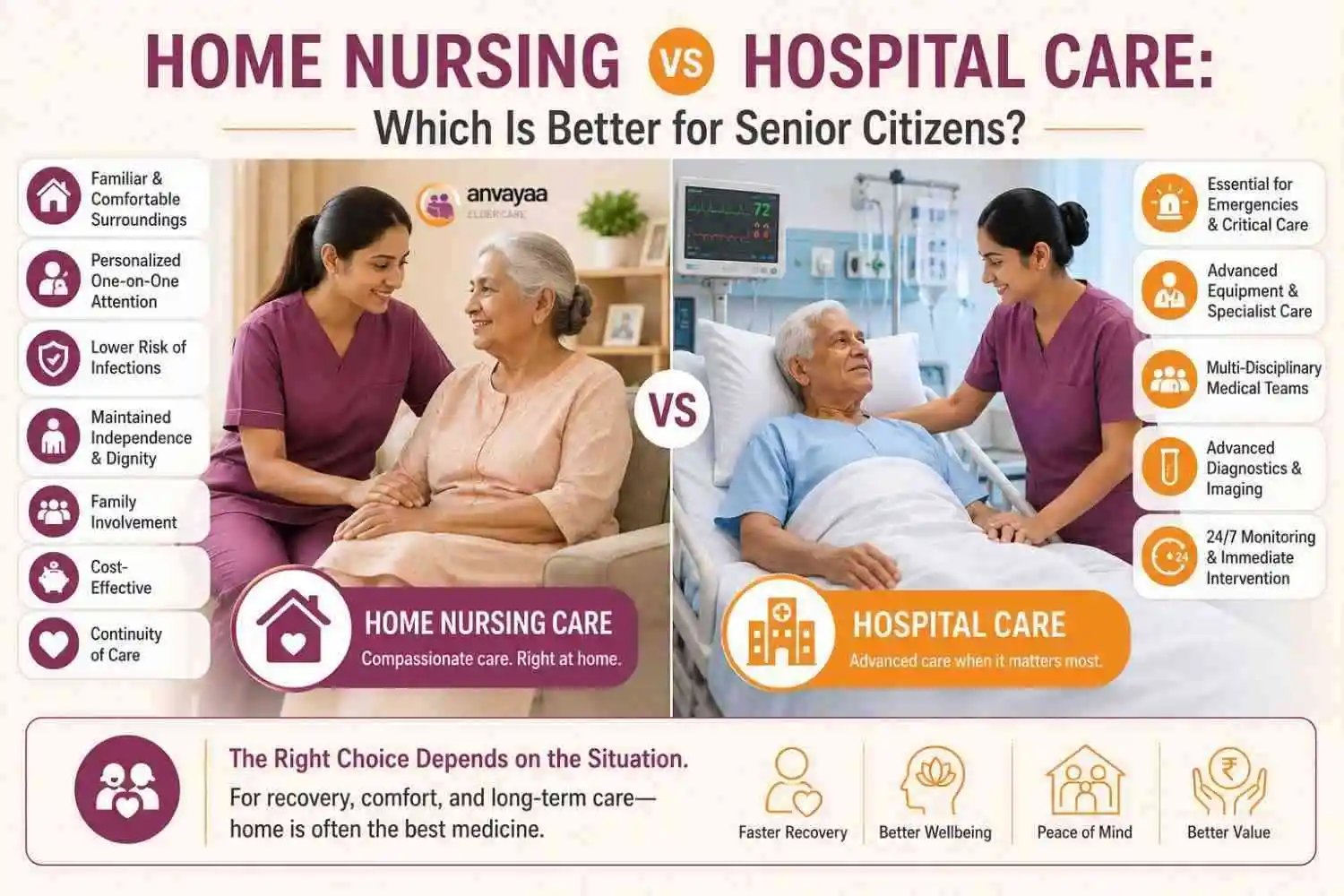
Hospitals are designed for acute medical situations — emergencies, surgeries, intensive monitoring, and conditions that require advanced equipment and round-the-clock specialist attention. They are, without question, essential for certain situations.
When Hospital Care Is Necessary
There are scenarios where hospitalization is not just preferable but critical:
- Emergency situations such as heart attacks, strokes, severe falls, or accidents
- Major surgeries that require operating theatres and post-operative monitoring
- Conditions requiring ICU-level care, ventilators, or continuous vital sign monitoring
- Diagnostic procedures that need specialized imaging or laboratory equipment
- Situations where a patient’s condition is unstable and could deteriorate rapidly
In these cases, the hospital’s infrastructure, multi-disciplinary teams, and immediate access to emergency interventions can be lifesaving.
The Drawbacks of Hospital Stays for Seniors
However, once a senior is medically stable, prolonged hospital stays can actually work against their recovery and wellbeing. Some of the common challenges include:
- Hospital-acquired infections. Hospitals, despite strict hygiene protocols, are environments where multiple patients with different infections are treated. Seniors, whose immune systems are often weaker, are more vulnerable to picking up infections during extended stays.
- Disorientation and confusion. Unfamiliar surroundings, constant noise, bright lights, and disrupted sleep cycles can cause or worsen confusion in elderly patients, a condition often referred to as “hospital delirium.”
- Loss of independence. Hospital routines are built around the institution’s schedule, not the patient’s. This can leave seniors feeling like they have no control over even small daily decisions — what to eat, when to sleep, when to move around.
- Emotional and psychological strain. Being away from family, familiar faces, and personal belongings can increase feelings of anxiety, loneliness, and depression, especially for seniors who are already dealing with the stress of illness.
- High costs. Extended hospital stays, especially in private facilities, can be financially draining, with charges for room rent, nursing staff, consumables, and more adding up quickly.
- Risk of immobility. Bed rest in a hospital setting, even when not strictly necessary, can lead to muscle weakness, reduced mobility, and a higher risk of complications like bedsores or blood clots.
Understanding Home Nursing Care for Seniors
Home nursing care involves bringing trained medical professionals — nurses, attendants, physiotherapists, and even doctors for periodic visits — directly to the patient’s home. This model has gained significant popularity in recent years, particularly for elderly patients who need ongoing support, post-hospitalization recovery care, or management of chronic conditions.
What Home Nursing Care Typically Includes
Depending on the level of care needed, home nursing services can cover:
- Administration of medications and injections
- Wound dressing and post-surgical care
- Monitoring vital signs (blood pressure, sugar levels, oxygen saturation, and so on)
- Assistance with mobility, physiotherapy, and rehabilitation exercises
- Help with daily activities like bathing, grooming, and feeding
- Catheter care, feeding tube management, and other specialized nursing tasks
- Companionship and emotional support
- Coordination with doctors for follow-ups and reviews
The Benefits of Home Nursing Care for Seniors
- Familiar, comfortable surroundings: There’s a reason recovery often happens faster at home. Seniors are surrounded by their own belongings, routines, and the people they love. This familiarity reduces stress and can have a measurable positive impact on both mental and physical health.
- Personalized, one-on-one attention: Unlike a hospital ward where a nurse might be responsible for several patients at once, home nursing care typically means dedicated, individual attention tailored to that specific person’s needs and preferences.
- Lower risk of infection:. Without exposure to other patients carrying various illnesses, the risk of picking up secondary infections drops significantly.
- Maintained independence and dignity: Seniors can continue to make choices about their day — when to eat, what to wear, when to rest — which helps preserve their sense of autonomy and self-worth.
- Family involvement: Family members can stay closely involved in the care process, observe progress firsthand, and provide the emotional support that’s so important during recovery or chronic illness management.
- Cost-effectiveness: For many situations, especially long-term or chronic care needs, home nursing care can be considerably more affordable than an extended hospital stay, while still providing professional medical support.
- Continuity of care: A consistent caregiver who knows the patient’s history, preferences, and routines can often spot subtle changes in condition more quickly than rotating hospital staff would.
When Home Nursing Care May Not Be Enough
It’s important to be realistic — home nursing care isn’t a replacement for hospital care in every situation. If a senior’s condition is unstable, requires emergency intervention, or needs equipment and monitoring that simply can’t be replicated at home, a hospital remains the right choice. Home nursing care works best for stable, chronic, or recovery-phase conditions rather than acute emergencies.
Home Nursing Care vs Hospital Care: A Side-by-Side Look
Factor |
Hospital Care |
Home Nursing Care |
| Best suited for | Emergencies, surgeries, unstable conditions | Recovery, chronic illness management, post-surgical care |
| Environment | Clinical, often unfamiliar | Familiar, personal, comfortable |
| Attention | Shared among multiple patients | One-on-one, personalized |
| Infection risk | Higher, due to shared spaces | Lower |
| Cost (for extended stays) | Generally higher | Often more economical |
| Family involvement | Limited by visiting hours | Continuous and direct |
| Emotional wellbeing | Can be stressful, isolating | Generally more reassuring |
| Mobility and independence | Often restricted | Encouraged and supported |
Making the Right Choice for Your Loved One
The decision between home nursing care and hospital care doesn’t have to be either-or. In fact, the most effective approach for many families is a combination: hospital care for the acute, critical phase of treatment, followed by home nursing care for recovery, rehabilitation, and ongoing management once the senior is medically stable.
When making this decision, families should consider:
- The current medical condition and stability of the senior
- Doctor’s recommendations regarding the level of monitoring required
- The availability and training of caregivers if opting for home care
- The home environment’s suitability (accessibility, hygiene, space for medical equipment if needed)
- The emotional preferences of the senior themselves — many elderly individuals strongly prefer to be at home
- Long-term cost implications of each option
Open conversations with doctors, care coordinators, and the senior themselves are essential to arriving at a decision that balances medical safety with quality of life.
How Anvayaa Helps with Home Nursing Care
This is where Anvayaa steps in to bridge the gap between hospital-level professional care and the comfort of home.
Anvayaa is a senior care platform built specifically to support families — especially those with elderly parents living independently or with limited support nearby — by providing reliable, professional, and compassionate care services right at home. Here’s how Anvayaa makes home nursing care a practical and trustworthy option for seniors:
- Trained and verified caregivers. Anvayaa provides access to trained nurses, attendants, and caregiving staff who are screened and verified, so families can feel confident about who is caring for their loved ones.
- Customized care plans. Every senior’s needs are different. Anvayaa works to understand the specific medical, mobility, and personal care requirements of each individual and puts together a care plan suited to those needs, whether that’s post-surgical recovery, chronic disease management, or general assistance with daily living.
- Round-the-clock support and monitoring. For families who can’t be physically present, Anvayaa’s model is designed to provide reassurance through regular updates, monitoring, and coordination, so that care continues smoothly even when family members are at work or living in a different city.
- Coordination with medical professionals. Home nursing care works best when it’s connected to the broader healthcare picture. Anvayaa helps coordinate with doctors for follow-up visits, medication management, and health reviews, ensuring continuity between hospital treatment and home recovery.
- Support for a wide range of needs. From basic companionship and daily living assistance to more involved nursing tasks like wound care, injections, and physiotherapy support, Anvayaa’s services are designed to flex according to what each senior actually requires at any given stage of their care journey.
- Peace of mind for families. Perhaps most importantly, Anvayaa aims to give adult children and family members — many of whom live far away from aging parents — the confidence that their loved ones are being looked after attentively, professionally, and with genuine care, even when they themselves can’t be there in person.
By combining trained medical support with the comfort and familiarity of home, Anvayaa helps seniors recover and live with dignity, while giving families the reassurance that quality care is just a call away.
Final Thoughts
Both hospital care and home nursing care have important roles to play in supporting the health of senior citizens. Hospitals remain indispensable for emergencies, surgeries, and conditions requiring intensive monitoring. But for recovery, rehabilitation, and the ongoing management of chronic conditions, home nursing care often offers a gentler, more personalized, and more affordable path — one that lets seniors heal in the place they feel safest and most at ease: home.
For families navigating this decision, platforms like Anvayaa Elder Care make it easier to bring professional, reliable nursing care into the home, ensuring that seniors don’t have to choose between quality medical attention and the comfort of familiar surroundings. With the right support system in place, seniors can age with dignity, recover with confidence, and families can have the peace of mind they deserve.

0 Comments