


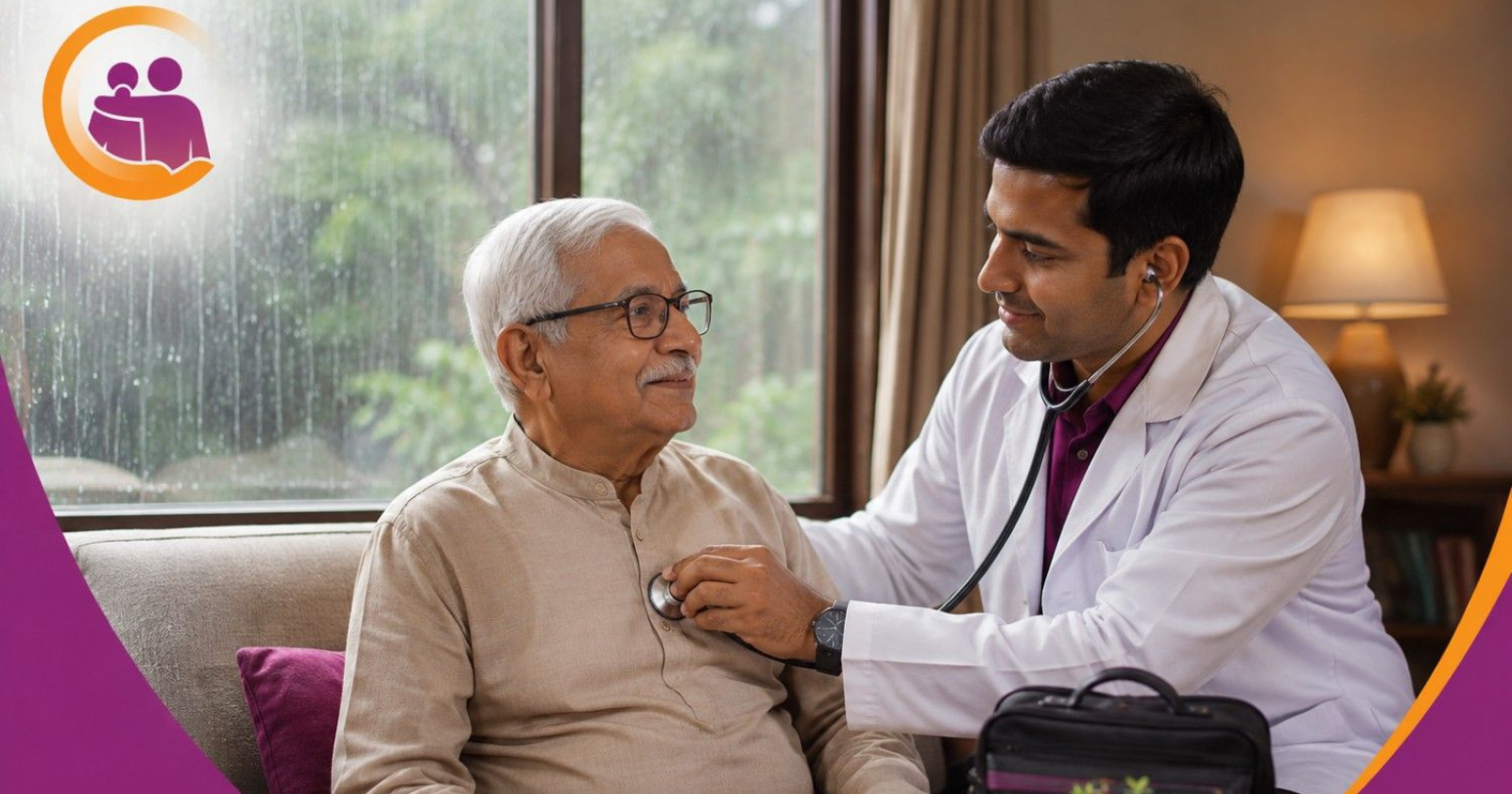
There is a particular kind of worry that settles over families with elderly parents when the monsoon arrives. The roads turn slippery, the air grows heavy with humidity, and the hospitals and clinics that were already busy become noticeably more crowded with seasonal illnesses. For a senior citizen managing diabetes, hypertension, arthritis, or a respiratory condition, the rainy season is not just an inconvenience — it is a period of genuinely elevated health risk, at precisely the time when getting to a doctor becomes most physically challenging.
This is one of the reasons doctor home visits for elderly individuals have moved from being an occasional convenience to a genuinely important model of care — particularly during the monsoon months, when the gap between what elderly patients need and what they can practically access grows widest.
Why the Rainy Season Creates Particular Health Risks for Seniors
Understanding why monsoon season demands more careful health management for elderly individuals helps clarify why access to medical care — and the form that access takes — matters so much during these months.
Infections spread more rapidly. Viral fevers, respiratory infections, and waterborne illnesses all peak during the rainy season. Elderly individuals, whose immune responses are naturally less robust, are disproportionately affected. What presents as a mild cold in a younger adult can escalate quickly into a chest infection or pneumonia in a senior citizen, particularly one already managing a chronic condition.
Humidity worsens respiratory conditions. For seniors living with asthma, COPD, or chronic bronchitis, monsoon humidity is a consistent trigger for flare-ups. These conditions require monitoring and timely medication adjustments that cannot be deferred until the patient is well enough to travel to a clinic.
Joint pain intensifies. The combination of cold, damp air and barometric pressure changes that accompany the rainy season is widely reported to worsen arthritis and joint pain in elderly individuals. Reduced mobility during this period increases the risk of falls, further limiting the patient’s ability to access care outside the home.
Waterlogging and slippery surfaces create fall risks. Wet floors, waterlogged streets, slippery footpaths, and unpredictable footing make any journey outside the home significantly more hazardous for a senior with reduced balance, weakened legs, or a history of falls. The journey to a hospital or clinic, in these conditions, carries its own health risk.
Chronic conditions require closer monitoring. Blood sugar levels, blood pressure, and other parameters in seniors managing chronic diseases can fluctuate during seasonal changes. This is precisely the time when more frequent medical oversight is valuable — and yet, paradoxically, the time when obtaining that oversight through conventional clinic visits is most difficult.
Doctor home visits for elderly patients during the monsoon directly address this paradox. The doctor comes to the patient, at the time when the patient most needs medical attention and is least able to safely seek it outside.
What Happens During a Doctor Home Visit for an Elderly Patient
For families who have not arranged a doctor home visit before, it is worth understanding what the visit actually involves and what it can accomplish.
A doctor visiting an elderly patient at home is not a substitute for a hospital in emergency or acute situations. Rather, it is the appropriate level of care for consultations, chronic disease monitoring, medication reviews, and the kind of clinical assessment that forms the backbone of good primary care.
During a typical home visit, the doctor will assess the patient’s current health status, check vital signs including blood pressure, oxygen saturation, temperature, and pulse, review current medications and make adjustments where necessary, examine any symptoms the patient or family has reported, order diagnostic tests if required through home sample collection services, and provide clear guidance to both the patient and the family on what to watch for and when to seek emergency care.
For seniors managing multiple conditions — which is the majority of elderly patients — the home setting also gives the doctor information that a clinic appointment never provides. The doctor sees the actual home environment: the arrangement of furniture that creates a fall risk, the medication bottles that tell a story of missed doses, the diet that the patient describes very differently when sitting in a clinic versus when the evidence is in the kitchen. These observations consistently lead to more complete, more accurate, and more useful clinical assessments.
The Monsoon Season and the Case for Regular Doctor Home Visits
For many elderly individuals, the rainy season becomes a period of quiet medical neglect — not because they do not need care, but because the practical barriers to accessing care outside the home become too high. Appointments get postponed. Symptoms that would ordinarily prompt a clinic visit get monitored at home and hoped away. Medication adjustments that should have happened three weeks ago keep getting deferred.
This pattern of deferred care during monsoon months is one of the most consistent contributors to health deterioration and emergency hospitalizations in elderly populations. The patient does not seek care when the problem is manageable, and by the time the situation demands hospital-level attention, it has escalated well beyond what it needed to be.
Scheduling regular doctor home visits for elderly family members during the monsoon months — even monthly, or fortnightly for those managing unstable chronic conditions — interrupts this pattern. It ensures that clinical oversight continues consistently regardless of the weather, the roads, or the patient’s mobility limitations on any given day.
Families who establish this routine during the monsoon typically report two outcomes that matter enormously: health problems are caught and addressed earlier, and the senior citizen’s confidence and peace of mind improve significantly, because they know that medical attention is accessible without requiring them to navigate difficult conditions outside.
Benefits of Doctor Home Visits for Senior Citizens
The benefits of doctor home visits for elderly individuals extend well beyond the convenience of avoiding travel. They represent a genuinely different — and in many respects superior — model of primary medical care for older adults. Here is a comprehensive look at what these visits offer.
Personalised, Unhurried Medical Attention: In a busy outpatient clinic, a doctor may have between seven and fifteen minutes to spend with each patient. For a senior citizen managing three or four chronic conditions, with a complex medication regime and several symptoms to discuss, fifteen minutes is rarely enough. Important details get missed. Questions the patient wanted to ask get forgotten in the clinical pressure of the setting.
A home visit operates on a different tempo. The doctor is present specifically for this patient. There is time to ask about the symptom that developed two weeks ago, to review the medication that the patient suspects is causing a side effect, to talk about the dietary change the family is uncertain about. This unhurried quality of attention consistently results in more complete assessment and better-informed medical decisions.
Reduced Exposure to Infections: Hospital waiting rooms and outpatient clinics are, by their nature, spaces where multiple patients with various illnesses are present simultaneously. For elderly individuals with compromised immune function, every clinic visit carries a measurable risk of exposure to infections that are entirely unrelated to the condition they came to address.
This risk is not theoretical — it is a consistent and documented contributor to illness in elderly patients who visit clinical settings frequently. Keeping the doctor’s visit in the home environment eliminates this exposure entirely. The senior receives the medical care they need without being placed in proximity to other patients whose conditions they are vulnerable to contracting.
Accurate Assessment Through Environmental Observation: As noted earlier, the home setting provides the doctor with clinical information that no clinic appointment can replicate. The state of the home, the patient’s natural movement patterns, the medication management system in place, the diet being consumed, the quality of sleep based on the bedroom arrangement, the fall risks present in the bathroom — all of these observations are immediately available to a doctor conducting a home visit.
This environmental picture consistently adds depth and accuracy to the clinical assessment. Medication non-compliance that a patient would never report in a clinic becomes apparent when the doctor sees three weeks of tablets still in the blister pack. Nutritional deficiency that wasn’t mentioned becomes understandable when the kitchen tells the story. These insights lead to interventions that are specific, practical, and genuinely useful rather than generically appropriate.
Continuity of Care and Relationship Building: When the same doctor visits an elderly patient at home regularly, a clinical relationship develops that has measurable health benefits. The doctor knows the patient’s baseline — how they normally present, what their usual blood pressure is, what their characteristic symptoms look like. This baseline knowledge means that changes are detected earlier and with greater confidence than when a patient sees a different doctor at each clinic visit.
For elderly individuals managing chronic conditions, this continuity is not a luxury — it is a clinical advantage. The doctor who knows the patient is better positioned to distinguish a meaningful change from normal variation, to notice the subtle early signs of deterioration before they become crises, and to make medication adjustments based on a longitudinal picture of the patient’s health rather than a single data point.
Reduced Physical and Emotional Strain on the Patient: The act of getting to a clinic is, for many elderly patients, a significant undertaking. Getting dressed, arranging transport, managing the physical discomfort of the journey, navigating the clinic environment, waiting, and then returning home — this sequence is tiring for anyone, and genuinely depleting for a senior citizen managing pain, breathlessness, or limited mobility.
This physical cost of clinic attendance is rarely factored into discussions about elderly healthcare access, but it is real and significant. Patients who find clinic visits exhausting defer them. And when they do attend, they often arrive in a state of fatigue that affects both the quality of the consultation and their recovery from it.
A doctor home visit eliminates this cost entirely. The patient is in their most comfortable, most familiar environment. They are not depleted by travel before the consultation begins. And they can rest immediately after it, without the journey home.
Family Involvement and Education: When a doctor visits an elderly patient at home, family members who are present have the opportunity to participate in the consultation in a way that a busy clinic setting rarely facilitates. They can describe what they have observed at home, ask questions they would not have thought to ask in a clinical setting, and receive guidance from the doctor on what to watch for, how to manage specific situations, and when to escalate to emergency care.
This family involvement is particularly valuable for elderly patients who may not fully recall everything discussed during the consultation, or who may minimize symptoms to the doctor in a way they would not if a family member were present to give a fuller picture.
For NRI families who cannot be physically present but can join a home visit via video call — an arrangement that doctors visiting homes are increasingly comfortable facilitating — this benefit extends across geographical distance as well.
Better Medication Management: Polypharmacy — the simultaneous use of multiple medications, which is common in elderly patients managing several chronic conditions — is one of the most significant sources of risk in elderly healthcare. Drug interactions, incorrect dosing, missed doses, and medication duplication are all more likely when a patient’s medications are managed across multiple specialists and never reviewed holistically.
A doctor conducting a home visit has the opportunity to conduct a comprehensive medication review — looking at everything the patient is currently taking, assessing for interactions and unnecessary duplications, simplifying the regime where possible, and ensuring that the patient and family understand exactly what each medication is for and when it should be taken. This review, done in the context of the patient’s home and daily routine, is more practically useful than the same conversation held in a clinic.
Frequent Hospital Visits? Here’s Why Home Doctor Visits Are a Better Option
There is a pattern that emerges in many elderly households that families gradually accept as normal, but is worth examining more carefully: the cycle of frequent hospital or clinic visits that consume significant time, energy, and money without actually improving the senior’s health management in any sustained way.
An elderly parent with hypertension, diabetes, and arthritis may have three or four different specialist appointments each month — a cardiologist, an endocrinologist, an orthopedic surgeon — each seeing a fragment of the patient without a complete picture of the whole. The patient travels to each appointment, waits, receives a brief consultation, travels home exhausted, and does this again in three or four weeks. The coordination between these different doctors may be minimal. The patient’s overall health trajectory may be unclear to any single one of them.
This fragmented, high-frequency hospital visit model is both physically costly for the elderly patient and medically suboptimal. It is expensive, exhausting, and structurally inclined to miss the integrated picture that good elderly care requires.
Advantages of Home Doctor Visits Over Frequent Hospital Visits
Integration over fragmentation. A general physician conducting regular doctor home visits for elderly patients can take a holistic view of the patient’s health — coordinating between specialists, reviewing all medications together, and maintaining a unified picture of how the patient is doing overall. This integrated oversight is difficult to achieve through multiple disconnected specialist visits.
Timely attention rather than deferred care. In the hospital and clinic model, care happens at scheduled intervals, regardless of whether the patient’s condition has changed between appointments. Home visits can be more responsive — arranged when a new symptom develops, when a medication adjustment needs monitoring, or when a seasonal health risk like the monsoon demands closer oversight.
The patient’s comfort and energy are preserved. A senior who is not depleted by the physical effort of clinic attendance is a patient who can engage more fully with the consultation, follow medical advice more effectively, and recover more completely from illness when it occurs.
Lower risk of hospital-acquired complications. Frequent visits to hospital environments carry a consistent risk of exposure to infections, particularly for elderly individuals with reduced immune function. Reducing unnecessary hospital attendance reduces this risk proportionally.
More meaningful time with the doctor. A home visit allows for a consultation that is tailored, unhurried, and conducted in the context of the patient’s actual life. The doctor sees and understands things that a brief clinic appointment cannot reveal.
Doctor at Home vs Hospital Visits: What’s Best for Elderly Care?
The answer to this question is not absolute — it depends on the nature and urgency of the medical need. Understanding where each model excels helps families make better decisions for their elderly loved ones.
Hospital and emergency care remains essential for:
- Acute emergencies — cardiac events, stroke, severe respiratory distress, significant falls with suspected fractures
- Procedures requiring clinical infrastructure — surgeries, complex diagnostic imaging, intravenous treatments
- Unstable conditions requiring intensive monitoring and specialist intervention
- Situations where the clinical presentation is unclear and comprehensive diagnostic workup is needed urgently
Doctor home visits for elderly individuals are the better choice for:
- Routine consultations and chronic disease management
- Medication reviews and prescription renewals
- Post-discharge follow-up after hospitalization, when the patient is still recovering
- Seasonal health management, including during the monsoon when travel is difficult
- Assessment of new or changing symptoms that are concerning but not immediately emergent
- Palliative care and comfort-focused management for seniors with advanced conditions
- Any situation where the physical or emotional cost of clinic travel is itself a barrier or a health risk
The optimal model for most elderly patients is not a binary choice but a complementary one: regular doctor home visits for elderly individuals to manage primary care and chronic conditions, supported by access to hospital or specialist care when the situation genuinely requires it.
How Anvayaa Facilitates Doctor Home Visits for Elderly Patients
Anvayaa Elder Care understands that access to medical care should not be limited by a senior’s ability to travel, the weather outside, or the absence of a family member to accompany them to a clinic. Through its care coordination model, Anvayaa facilitates doctor home visits for elderly patients across its service cities, connecting families with qualified physicians who visit the patient at home on a scheduled and as-needed basis.
Anvayaa’s Care Managers coordinate the visit, remain present to assist with communication and documentation, relay the doctor’s assessment and recommendations to family members — including those living overseas — and ensure that any follow-up actions, investigations, or medication changes are tracked and acted upon promptly.
For NRI families, this coordinated model means that their elderly parent receives regular medical oversight at home, and the family receives timely, clear updates on their parent’s health status — without the parent having to navigate clinic visits alone, and without the family having to manage remote care coordination without reliable on-ground support.
During the rainy season and throughout the year, Anvayaa’s approach to doctor home visits for elderly individuals reflects a straightforward conviction: quality medical care should come to the patient, not the other way around — especially when the patient is elderly, and especially when the journey itself carries more risk than it should.
Final Thoughts
The monsoon season brings into sharp relief a challenge that families with elderly parents navigate throughout the year: how do you ensure that a senior citizen receives the consistent, attentive medical care they need, without requiring them to repeatedly endure the physical strain and health risks of travelling to a clinic or hospital?
Doctor home visits for elderly individuals are not a luxury or a workaround. They are a thoughtful, evidence-supported model of primary care that is better suited to the needs of older adults than the conventional outpatient clinic model in many important respects. They offer personalised attention, environmental insight, reduced infection risk, family involvement, and the kind of continuity of care that genuinely improves health outcomes over time.
Whether your elderly parent is managing a chronic condition, recovering from a recent illness, facing the particular health challenges of the rainy season, or simply needs the reassurance of regular medical oversight without the exhaustion of frequent hospital visits — arranging doctor home visits for elderly care through a trusted provider like Anvayaa is a decision that protects their health, preserves their dignity, and gives the whole family greater peace of mind.
0 Comments