


When an NRI family books a return flight after a parent’s surgery, there is almost always a moment — quiet, difficult, and familiar to anyone who has lived it — where the question surfaces: who is going to make sure everything continues properly after I leave?
The surgery may have gone well. The hospital discharge may have been smooth. The physiotherapy exercises may have been demonstrated patiently by the hospital team. But the recovery — the real, daily, unglamorous work of healing — stretches across weeks and months that no amount of annual leave can cover.
For families whose elderly parents live in Chennai while they work and raise families abroad, this is not a hypothetical worry. It is the lived reality of thousands of households across the city. And for many of them, physiotherapy services at home in Chennai have become one of the most important answers to that question — a way of ensuring that recovery does not stall the moment the family member’s flight takes off.
The Benefits of Home Physiotherapy Services in Chennai for Post-Operative Care
Most orthopaedic surgeons and geriatricians will say the same thing plainly: surgery addresses the structural problem. Physiotherapy is what restores the function. A technically successful knee replacement, hip surgery, or fracture repair can still result in disappointing outcomes if physiotherapy is inconsistent, incorrectly performed, or abandoned too early.
For elderly patients recovering at home in Chennai, the barriers to consistent physiotherapy are real and varied.
Getting to a clinic two or three times a week is genuinely exhausting for a post-operative senior. Chennai’s traffic is demanding, the journey itself is uncomfortable when a joint is still healing, and the effort of travelling to a clinic — and back — often leaves the patient too drained to benefit fully from the session itself.
Home exercises prescribed by the hospital physiotherapist, meanwhile, are only effective when done regularly and with correct technique. Without supervision, many elderly patients skip sessions when pain is high, perform movements incorrectly out of habit, or quietly stop the programme altogether within a few weeks — often without telling anyone.
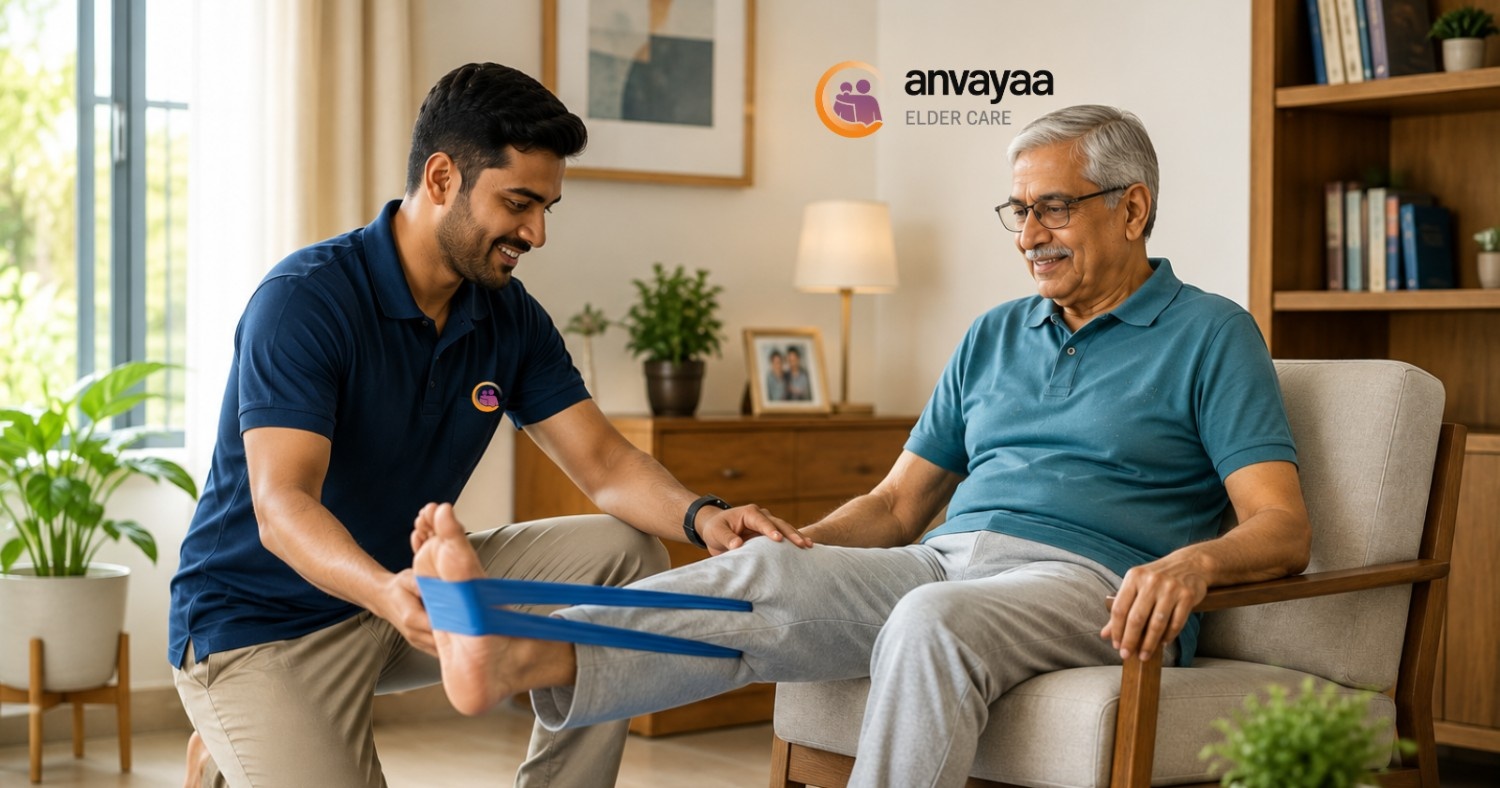
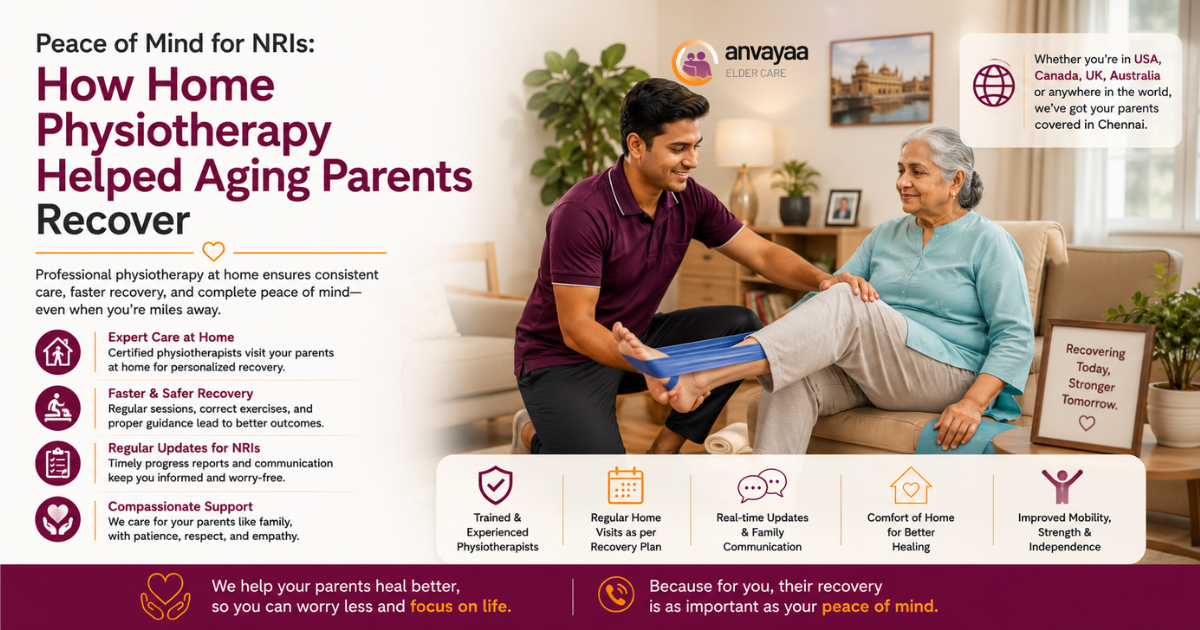
For NRI families, the additional gap is the absence of a trusted local person who can sit with their parent during exercises, observe how they are managing, and communicate progress back to the family. Physiotherapy services at home in Chennai close this gap directly: the professional comes to the patient, the sessions happen in the patient’s own environment, and the family can be kept informed regularly through calls, messages, and progress updates.
What Home Physiotherapy Recovery Actually Looks Like
When home physiotherapy is set up correctly for an elderly patient in Chennai, the difference in recovery outcomes is tangible and consistent.
A trained physiotherapist visits the patient at home on the scheduled days — typically three to five times a week in the early post-operative phase. Sessions last around 45 minutes and are adjusted each week as the patient’s strength and range of motion improve. The exercise programme is not static; it evolves with the patient’s progress.
Crucially, the physiotherapist observes the patient in their actual living environment. They notice that the bathroom has no grab bar and is a fall risk. They see that the sofa is too low for safe transfers. They observe the patient’s natural gait as they move around their own home, which often reveals compensatory patterns that a clinic setting — where patients tend to perform better because they are being watched in an unfamiliar space — would not reveal.
These observations become part of the care. The physiotherapist advises on home modifications, adjusts the exercise programme based on real-life movement patterns, and flags concerns to the family or the coordinating care team promptly.
For NRI families following their parent’s recovery from USA, Canada, UK, or Australia, this structure provides something that long-distance calls and video check-ins cannot: the assurance that someone qualified is physically present with their parent on a regular, reliable basis — watching, adjusting, encouraging, and reporting back.
What NRI Families Most Need from Physiotherapy Services at Home in Chennai
The clinical component of home physiotherapy — the exercises, the technique, the progression — is important. But for NRI families, the non-clinical dimensions of the service matter just as much.
They need to know that the physiotherapist will arrive on the scheduled days without the family having to follow up from abroad to confirm. They need updates that are proactive, not just responsive — hearing about progress before they have to ask, and being informed promptly if something changes or a concern arises. They need a service that understands that their parent may be resistant on difficult days, and that knows how to be patient and encouraging without being dismissive of genuine pain.
And they need continuity. One of the most disruptive experiences for an elderly patient is a constant rotation of different professionals coming to the home. When the same physiotherapist visits regularly, a relationship develops — the professional knows the patient’s baseline, understands their personality and pace, and can detect subtle changes that a newer face might miss.
When physiotherapy services at home in Chennai are organized through a trusted elder care platform like Anvayaa, these assurances are built into the service model. Care Managers coordinate the physiotherapy schedule, maintain communication with the family, accompany the patient to medical follow-ups, and ensure that the overall recovery plan remains on track — so that NRI families can manage their own responsibilities abroad with genuine, well-founded peace of mind rather than constant background anxiety.
Can Home Physiotherapy Prevent Long-Term Knee Pain? The Evidence and the Experience
One of the most important — and most underappreciated — roles of physiotherapy is not rehabilitation after an injury has already occurred, but prevention of the long-term damage that untreated pain and declining mobility cause over time.
Elderly individuals across Chennai frequently live with knee pain for years before seeking professional help. The adjustment is gradual: a walk gets shorter, a staircase gets avoided, a favourite activity gets given up. What looks like sensible adaptation is often something more damaging — a slow cycle of reduced movement, weakening muscles, increasing joint stress, and accelerating deterioration that could have been interrupted far earlier.
By the time many seniors in Chennai are referred for physiotherapy services at home in Chennai, the condition that might have been managed conservatively has often progressed to a point where surgical intervention is the only remaining option. And while surgery can restore function, it cannot undo the years of secondary damage — to adjacent joints, to gait patterns, to overall physical conditioning — that accumulated while the primary problem went unaddressed.
What Physiotherapy Does for the Ageing Knee
Osteoarthritis — the gradual wearing of the cartilage cushioning the knee joint — is the most common cause of chronic knee pain in elderly individuals. While the cartilage loss itself cannot be reversed, its progression is significantly influenced by factors that physiotherapy directly addresses.
Muscle strengthening is perhaps the most important. Strong quadriceps, hamstrings, and calf muscles act as shock absorbers for the knee, reducing the direct load on the joint surface with every step. Elderly patients who maintain good surrounding muscle strength consistently experience less pain and slower cartilage deterioration than those with weak muscles, even when the underlying joint damage is similar.
Gait correction addresses the compensatory movement patterns that develop when someone has been walking around pain for months or years. Limping, favouring one leg, or altering posture to reduce knee load all create secondary problems — in the opposite knee, in the hips, and in the lower back — that compound the original issue over time. A physiotherapist identifies and corrects these patterns before they cause lasting structural damage.
Flexibility and range of motion work prevents the progressive stiffening of the joint that limits movement and makes daily activities increasingly difficult. Maintaining joint mobility is significantly easier than restoring it once lost.
Balance and proprioception training improves the body’s awareness of joint position, which reduces the risk of falls — one of the most serious and most preventable threats to elderly health and independence.
For elderly patients in Chennai who begin physiotherapy services at home in Chennai early — before a condition has reached the point of requiring surgery — the goal is not just symptom relief. It is the preservation of function and independence over the long term.
After Surgery: How Home Physiotherapy Shapes the Recovery Outcome
For those who do proceed to knee replacement or other orthopaedic surgery, post-operative home physiotherapy plays an equally decisive role in how well — and how fully — the patient recovers.
The early post-operative phase, typically the first six weeks, is when the foundations of recovery are built. Range of motion exercises begun in this period prevent the scar tissue formation and joint stiffening that can permanently limit movement if left unaddressed. Strengthening exercises begun as soon as the surgeon permits start rebuilding the muscle support that protects the new joint.
The middle phase of recovery — weeks six through twelve — is when most patients start to feel significantly better and are at their highest risk of doing too much too soon or discontinuing structured physiotherapy before the work is complete. A physiotherapist who visits the home regularly keeps the patient on the correct progression, prevents overexertion, and maintains the momentum of recovery through the period when motivation and professional guidance are most likely to lapse.
The long-term programme — extending beyond the acute recovery phase — is what determines whether the patient returns to full functional capacity or plateaus at a level of recovery that is better than before surgery but still short of what was achievable.
Home physiotherapy, organized through a reliable provider of physiotherapy services for elders in Chennai, ensures that all three phases are covered consistently, correctly, and with the kind of personalized attention that a busy outpatient clinic setting rarely has the capacity to provide.
5 Mistakes Families Make During Home Physiotherapy Recovery
Families caring for elderly parents through a physiotherapy recovery programme almost always begin with the best intentions. The mistakes that undermine recovery are rarely made out of carelessness — they are made out of misunderstanding, misplaced compassion, or simply not knowing what good home physiotherapy management looks like. Here are the five most common mistakes, and how to avoid each one.
Mistake 1: Allowing Sessions to Be Skipped on Difficult Days
The most consistent pattern that undermines home physiotherapy recovery is the gradual erosion of the session schedule on days when the patient is in pain, fatigued, or unwilling.
The instinct to let the patient rest when they are struggling is compassionate and understandable. The problem is that difficult days are frequent in the early weeks of recovery, and if sessions are regularly skipped whenever the patient feels uncomfortable, the programme loses the continuity that makes it effective. Joint stiffness sets in between gaps. Muscles lose the conditioning built in previous sessions. The overall recovery timeline extends.
The critical distinction — between discomfort that is expected and should be worked through gently, and pain that signals something clinically wrong — is a clinical judgement. It is the physiotherapist’s judgement to make, not the patient’s or the family’s. When a trained professional is present, they make this call correctly every session.
The right approach: Make the physiotherapist the decision-maker on whether a session proceeds, is modified in intensity, or is genuinely postponed. Remove the decision from the patient’s mood or the family’s anxiety, and place it with the professional whose training is designed for exactly this judgement.
Mistake 2: Assuming Home Exercises Will Happen Without Supervision
The physiotherapist’s visits — typically three to five times a week — account for a fraction of the total rehabilitation time. The home exercise programme prescribed for the remaining hours of every day is where the majority of recovery work actually happens. And it is the part that most commonly gets quietly abandoned.
Without someone checking, gently reminding, and sitting with the patient during home exercises, many elderly individuals do fewer repetitions than prescribed, use incorrect technique that reduces effectiveness or risks injury, or stop the programme entirely within a few weeks.
Families often assume that because exercises have been demonstrated and written down, follow-through will happen naturally. It rarely does consistently, particularly in the weeks when pain and fatigue are still significant.
The right approach: Treat the home exercise programme as a structured, scheduled activity — not something that happens when the patient feels ready. Build a fixed daily time for it. If a caregiver or home attendant is present, brief them on the exercises and ask them to be present during the session. For NRI families, a scheduled video call during exercise time provides both supervision and encouragement from a distance.
Mistake 3: Overlooking the Home Environment as a Safety and Recovery Factor
The home environment directly shapes both the safety and the effectiveness of physiotherapy recovery. A home full of fall hazards, awkward furniture arrangements, or poorly designed bathroom facilities creates daily risk for an elderly patient who is still rebuilding strength and balance.
Common hazards that families overlook include loose rugs and floor mats, slippery bathroom tiles without grab bars, toilets at standard height that require deeper knee bending than the surgeon permits, beds that are too low for safe transfers, and inadequate lighting in corridors and bathrooms used at night.
A fall during the recovery period — even a minor one — can set recovery back significantly. A fall that results in a new injury can be devastating.
The right approach: Conduct a room-by-room safety assessment of the home before the patient is discharged from hospital. Remove or secure floor coverings that pose a slip risk. Install grab bars in the bathroom. Arrange an elevated toilet seat or commode chair if required. Ask the physiotherapist to walk through the home during one of the early sessions and identify specific risks that the family may not notice.
Mistake 4: Treating Medical Follow-Up Appointments as Optional
As home physiotherapy progresses and the patient begins to feel better, some families start treating the surgeon’s follow-up appointments as less urgent — something that can be rescheduled, postponed, or eventually forgotten.
This is a pattern with potentially serious consequences. Medical follow-up appointments serve a different and complementary purpose to physiotherapy. They allow the surgeon to assess wound healing, review imaging to confirm the joint is settling correctly, identify early signs of complications — infection, implant-related issues, or concerning changes in the healing process — and adjust the medical management plan as needed.
No amount of progress in physiotherapy can substitute for clinical oversight of the surgical recovery. The two tracks must run in parallel.
The right approach: Treat follow-up appointments as fixed, non-negotiable components of the recovery plan. For NRI families who cannot accompany their parent to these appointments, coordinating with a Care Manager service — such as Anvayaa — ensures that the patient is accompanied, the doctor’s feedback is properly recorded, and any new medical instructions are communicated to the family and incorporated into the home care plan without anything falling through the gaps.
Mistake 5: Stopping Physiotherapy When the Patient Feels Better
This is perhaps the most common mistake of all — and the one whose consequences are least immediately visible, making it easy to rationalize.
When an elderly patient starts walking comfortably, pain reduces to manageable levels, and daily activities become easier, families often conclude that physiotherapy has accomplished its goal. Sessions are gradually reduced and then discontinued, often without any formal discharge from the physiotherapist.
The point at which the patient feels better is typically not the point at which the physiotherapy programme should end. It is usually the point at which the most important phase is beginning — consolidating strength, normalizing gait patterns, restoring full range of motion, and building the long-term muscle conditioning that will protect the joint and reduce the risk of re-injury or adjacent joint problems for years to come.
Stopping too early leaves the patient better than they were before, but short of the recovery that was achievable — and often more vulnerable than they need to be to future problems.
The right approach: The decision to conclude a physiotherapy programme should come from the physiotherapist, based on objective assessments of strength, range of motion, balance, and functional capacity — not from the patient’s subjective sense that things feel fine, or the family’s assumption that visible improvement means the work is done.
How Anvayaa’s In home Physiotherapy Services Address These Mistakes
Each of the five mistakes above is a predictable failure point in home physiotherapy recovery — and each is preventable with the right structure and oversight.
Anvayaa coordinates At home physiotherapy services in Chennai with a care management model that is specifically designed to prevent these failures. Qualified physiotherapists are scheduled consistently. Home safety assessments are part of the early care plan. Medical follow-up appointments are coordinated and accompanied by Anvayaa’s Care Managers, who communicate the outcomes to families wherever they are in the world. The home exercise programme is supervised by the caregiving team present in the home. And the overall recovery plan is managed through to its appropriate conclusion — not dropped when the patient starts feeling better.
For families in Chennai — both resident and NRI — this end-to-end coordination means that the physiotherapy programme delivers what it is capable of delivering, without the common gaps and drop-offs that so frequently prevent full recovery.
Final Thoughts
Home physiotherapy is one of the most powerful tools available for elderly individuals recovering from surgery, managing chronic joint conditions, or working to preserve mobility and independence as they age. But its effectiveness is not automatic — it depends entirely on consistency, correct technique, a safe home environment, appropriate medical oversight, and a care structure that keeps the patient on track through the full length of the recovery journey.
For families across Chennai, and for NRI families supporting ageing parents from abroad, physiotherapy services at home in Chennai — coordinated through a trusted and experienced partner like Anvayaa — offer a path to recovery that is safer, more consistent, and more effective than navigating these challenges without support.
The goal is not simply to recover from today’s pain or today’s surgery. It is to give elderly parents the strongest, most capable, and most independent life they can have in the years that follow.

0 Comments