


Knee replacement surgery — medically known as total knee arthroplasty — is one of the most commonly performed orthopaedic procedures in India today, and for good reason. For seniors who have spent years battling severe arthritis, chronic knee pain, or mobility limitations, a successful knee replacement can be genuinely life-changing. It can restore the ability to walk comfortably, climb stairs, and move through daily life with far greater ease and confidence.
But here’s the truth that many families learn only after the surgery: the operation itself is just the beginning. What happens in the weeks and months that follow — the post operative care, the rehabilitation, the daily routines, the emotional adjustments — determines how well the patient actually recovers. A knee replacement with poor post operative care can lead to complications, slower healing, and outcomes that fall far short of what was possible.
This blog walks through everything families need to know about post operative care after knee replacement surgery — the dos, the don’ts, the recovery timeline, and the specific challenges faced by NRI families managing their parents’ care from thousands of miles away.
Understanding the Recovery Journey After Knee Replacement
Recovery from knee replacement surgery is not a single event — it’s a gradual process that unfolds across several phases, each with its own milestones and requirements.
In the hospital (Days 1–3): Most patients are encouraged to begin standing and taking their first steps with support within 24 hours of surgery. This early mobilization is intentional — it reduces the risk of blood clots and helps the body begin adapting to the new joint. Pain management, wound care, and supervised physiotherapy exercises begin immediately.
Early recovery at home (Weeks 1–6): Once discharged, the patient enters the most critical phase of recovery. They are still in significant pain, their mobility is limited, and they require consistent support for nearly every daily activity. This is the period where professional post operative care makes the most difference.
Rehabilitation phase (Weeks 6–12): By this stage, most patients are walking with or without a walking aid, regaining strength, and working through structured physiotherapy. Independence gradually returns, but caution and support remain essential.
Long-term recovery (Months 3–12): Full recovery from knee replacement surgery can take up to a year. Strength continues to build, swelling reduces progressively, and most patients achieve the mobility improvement that prompted the surgery in the first place.
Understanding this timeline helps families set realistic expectations and plan the right level of care at each stage.
Post Operative Care After Knee Replacement: The Dos
Do Follow the Physiotherapy Routine Diligently
Physiotherapy is not optional — it is the cornerstone of a good knee replacement recovery. The exercises prescribed by the physiotherapist help restore range of motion, rebuild muscle strength around the new joint, and prevent stiffness. Patients who skip or delay physiotherapy consistently have poorer outcomes than those who follow their exercise programme faithfully, even when it’s uncomfortable.
In the early weeks, a physiotherapist should ideally visit the patient at home to supervise exercises correctly. Incorrect technique can slow recovery or cause injury. As the patient gains confidence, exercises can increasingly be done independently with supervision.
Do Manage Pain Proactively
Post operative pain is real and expected after knee replacement surgery. The key is managing it proactively rather than waiting until pain becomes severe. Medications should be taken on the schedule prescribed by the surgeon, ice packs applied to reduce swelling, and the leg elevated when resting.
Pain that is well managed allows the patient to engage more effectively with physiotherapy exercises — which in turn leads to faster, better recovery. Undertreated pain, on the other hand, causes patients to move less, which leads to stiffness and slower healing.
Do Keep the Wound Clean and Dry
Infection is one of the most serious complications after knee replacement surgery. The surgical wound must be kept clean and dry until it is fully healed, as per the surgeon’s instructions. Dressings should be changed by a trained nurse at the frequency recommended by the doctor. Any signs of infection — redness spreading beyond the wound, warmth, unusual discharge, fever, or increasing rather than decreasing pain — must be reported to the surgeon immediately without delay.
Do Use Mobility Aids Correctly
A walker, crutches, or a walking stick are not signs of weakness — they are essential safety tools in the early weeks of recovery. Falls after knee replacement surgery are dangerous and can cause serious setbacks. All mobility aids should be used as instructed by the physiotherapist, and the home environment should be arranged to minimize fall risks.
Do Eat Well and Stay Hydrated
Nutrition plays a critical and often underestimated role in surgical recovery. Adequate protein is essential for tissue healing. Calcium and Vitamin D support bone health. Staying well hydrated helps the body manage post operative swelling and supports overall healing. For diabetic patients, blood sugar management during the recovery period is particularly important, as elevated blood sugar slows healing and increases infection risk.
Do Attend All Follow-Up Appointments
Post operative follow-up appointments with the orthopaedic surgeon are not just formalities. They allow the surgeon to assess wound healing, check the alignment of the new joint, monitor for complications, and adjust the recovery plan as needed. Missing follow-ups can mean that developing problems go undetected until they become serious.
Do Keep the Leg Elevated When Resting
Elevating the operated leg when sitting or lying down helps reduce swelling, which is a normal and expected part of recovery but can become uncomfortable and slow healing if not managed. A pillow placed under the calf and heel (not under the knee itself, which can cause flexion contracture) is the standard recommendation.
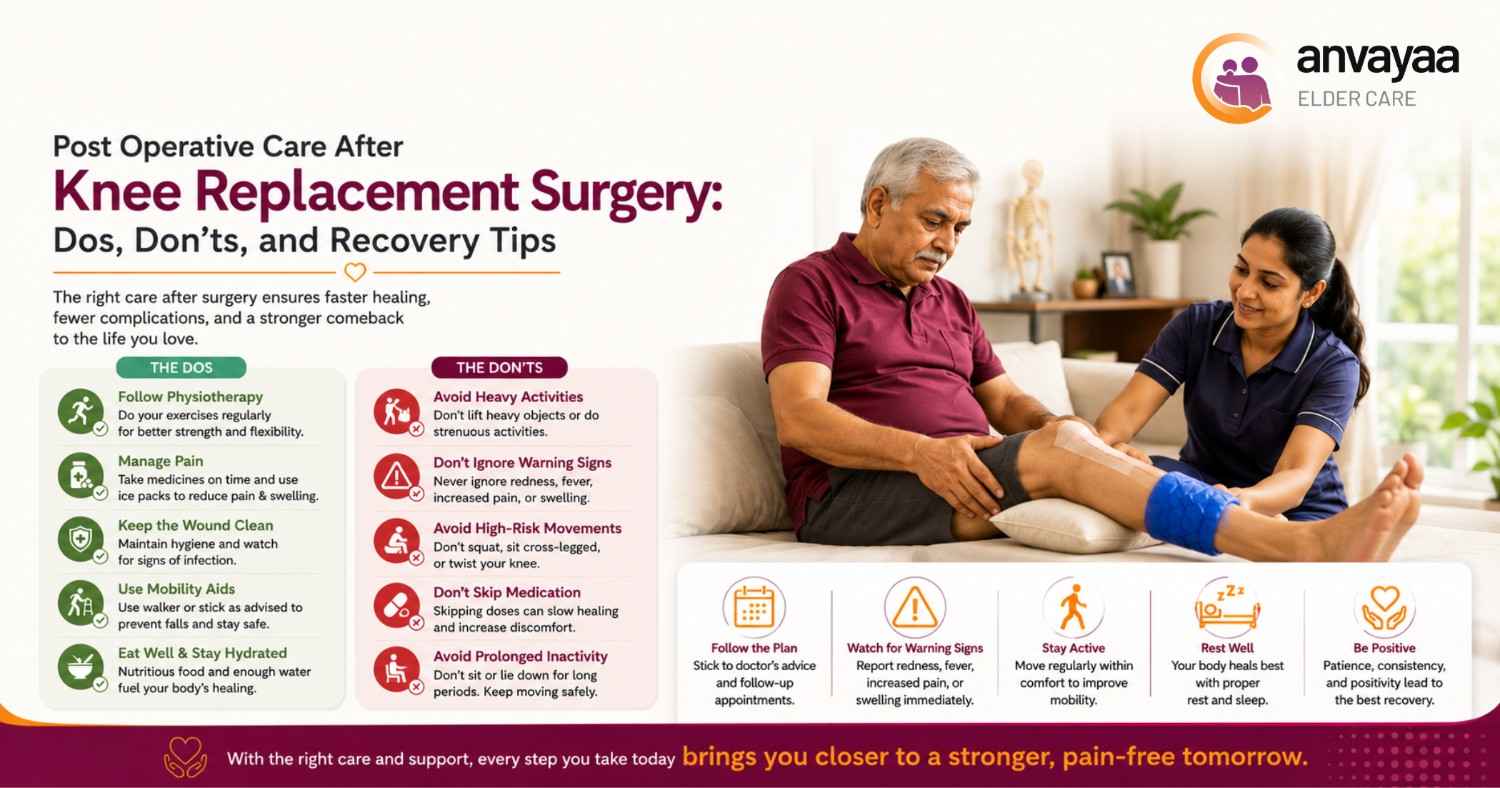
Post Operative Care After Knee Replacement: The Don’ts
Don’t Skip or Rush Through Physiotherapy Exercises
The temptation to rest and avoid movement when the knee is painful is understandable but counterproductive. Immobility after knee replacement surgery leads to stiffness, muscle weakness, and scar tissue formation that can permanently limit the range of motion of the new joint. Exercises must be done consistently and with proper technique, even when they’re uncomfortable — always within the limits prescribed by the physiotherapist.
Don’t Ignore Warning Signs
Certain symptoms after knee replacement surgery require immediate medical attention. These include increasing redness, warmth, or swelling around the wound; discharge from the surgical site; fever above 38.5°C; sudden severe increase in pain; calf pain or swelling (which could indicate a deep vein thrombosis); or shortness of breath and chest pain (which could indicate a pulmonary embolism). These are not symptoms to wait and watch — they require prompt medical evaluation.
Don’t Put Unnecessary Stress on the New Joint
In the early weeks and months, the new joint is still stabilizing and the surrounding muscles are still rebuilding. High-impact activities, kneeling on the operated knee, squatting low to the ground, sitting cross-legged on the floor, climbing steep stairs unnecessarily, or using Indian-style toilets (which require deep knee flexion) should be avoided as per the surgeon’s guidance.
Don’t Neglect Blood Clot Prevention
Deep vein thrombosis (DVT) — blood clots forming in the legs — is a known risk after knee replacement surgery. Blood thinning medications are typically prescribed for this reason, and it is critical that these are taken as directed. Leg exercises, staying mobile (within comfort limits), wearing compression stockings if prescribed, and staying hydrated all contribute to reducing DVT risk.
Don’t Allow the Patient to be Alone in the Early Weeks
The early post operative period is a time when the patient needs help with almost everything — getting to the bathroom, climbing stairs, moving from bed to chair, bathing, and managing meals. Leaving a senior who has just undergone knee replacement surgery alone, even for short periods, carries real fall and safety risks. Consistent supervision and support during this phase is not overprotective — it’s essential.
Don’t Underestimate the Emotional Side of Recovery
Knee replacement recovery is not just physically demanding — it’s emotionally taxing too. Many patients experience frustration, low mood, or even mild depression in the early weeks, particularly when pain is high and progress seems slow. Acknowledging these emotions, maintaining social connection, keeping the patient engaged and motivated, and celebrating small milestones all matter for recovery.
Recovery Tips for a Smoother Healing Journey
- Prepare the home before surgery. Remove loose rugs, install grab bars in the bathroom and near the toilet, arrange a comfortable recovery space on the ground floor if possible, and ensure essentials are within easy reach.
- Set up a bedside kit. Keep medications, water, the TV remote, phone charger, and any other frequently needed items within arm’s reach to minimize unnecessary movement.
- Use an elevated toilet seat. Standard Indian toilets are too low for comfort and safety after knee replacement surgery. An elevated toilet seat or commode chair is a practical and important investment.
- Track medication timings carefully. Use a pill organizer or medication reminder app to ensure pain medications, anti-coagulants, and other prescribed medicines are taken on time.
- Sleep positioning matters. Most surgeons recommend sleeping with the leg elevated but not bent under pillows at the knee. A physiotherapist can advise on the best sleeping position for each patient.
- Ice therapy is your friend. Applying ice packs to the knee for 15–20 minutes several times a day (wrapped in a cloth to protect the skin) helps manage swelling and pain naturally.
- Progress is not linear. Some days will feel like a step backward — increased pain, fatigue, or discouragement. Families and patients should be reassured that recovery has its ups and downs, and that setbacks do not necessarily mean something is wrong.
Why NRI Families Choose Professional Post Operative Care for Their Parents
For the thousands of Indian families whose children live and work overseas — in the United States, United Kingdom, Canada, Australia, the Gulf, and beyond — a parent undergoing knee replacement surgery presents a particularly acute challenge.
The surgery can be planned and the immediate hospital stay managed during a visit home. But knee replacement recovery takes weeks and months — a timeline that rarely fits within the window of leave that NRI children can realistically take from their work and families abroad. The result is an all-too-common and deeply painful situation: a parent recovering from major surgery, managing pain and physiotherapy and wound care, alone or with only minimal family support, while their children watch helplessly from thousands of miles away.
This is precisely why professional post operative care services have become so important for NRI families — and why the demand for trusted, well-organized home-based care is growing rapidly in cities across India.
The NRI Family’s Specific Concerns
NRI families dealing with a parent’s post operative care face a distinct set of worries:
- Who will make sure physiotherapy exercises are being done correctly and consistently?
- Who will monitor the wound and notice early signs of infection before they escalate?
- Who will accompany the parent to follow-up appointments when the child cannot be there?
- Who will manage medications, ensure the right diet, and be present at night if the parent needs help?
- Who can they call if something goes wrong at 2 a.m. in Hyderabad when they’re in Houston?
These are not abstract worries. They are practical, daily concerns that weigh on NRI families during every post operative recovery their parents go through.
How Anvayaa Supports NRI Families with Post Operative Care
Anvayaa has become a trusted partner for NRI families across India precisely because its model is built to address these exact concerns.
Dedicated Care Managers as the family’s local eyes and ears. Anvayaa’s Care Managers serve as the on-ground family representative — visiting the parent regularly, attending hospital follow-ups, coordinating with the physiotherapist and surgeon, and providing the NRI child with regular updates via WhatsApp, photos, and calls. For a family in New Jersey or London, this is the assurance that someone trustworthy is watching over their parent every day.
Coordination of home nursing and physiotherapy. Anvayaa coordinates trained nurses for wound dressing changes, vital sign monitoring, and medication management at home. For physiotherapy, Anvayaa facilitates empanelled physiotherapists who visit the patient at home, ensuring the exercise programme is followed correctly and the patient progresses steadily through recovery.
Emergency response and hospital accompaniment. If complications arise — a fever, a fall, a sudden worsening of pain — Anvayaa’s Care Manager responds on the ground immediately. The parent is not left alone to manage a medical situation without support, and the NRI family is informed in real time so they can make informed decisions from wherever they are.
Caregiver and wardgirl services. For the early weeks of recovery when the patient needs hands-on daily assistance with bathing, mobility, meals, and basic personal care, Anvayaa facilitates trained caregivers and ward attendants who provide consistent, compassionate support.
Nutrition and daily living support. Through its maid and cook services, Anvayaa ensures that the recovering senior receives nutritious, appropriate meals every day — a detail that makes a genuine difference to healing speed and overall wellbeing.
Regular structured updates. One of the most valued aspects of Anvayaa’s service for NRI families is the peace of mind that comes from consistent, reliable communication. Families abroad don’t need to anxiously wonder how the recovery is going — they know, because Anvayaa tells them.
For NRI families, Anvayaa is not just a service — it is the local presence they cannot be themselves. It bridges the geographical gap that causes so much guilt and worry for adult children who genuinely want to be there for their parents but cannot always be physically present. With Anvayaa coordinating post operative care, NRI families can focus on their own lives and responsibilities abroad with the confidence that their parents are being cared for professionally, compassionately, and reliably — every single day of the recovery journey.
Final Thoughts
Knee replacement surgery opens a door to a better quality of life for seniors struggling with chronic pain and limited mobility. But walking through that door successfully depends almost entirely on the quality of post operative care that follows the surgery. Doing the right things — consistent physiotherapy, proper wound care, good nutrition, fall prevention, timely follow-ups — and avoiding the wrong ones makes the difference between a recovery that delivers on its promise and one that falls short.
For families in India and NRI families abroad, professional post operative care services like those offered by Anvayaa ensure that seniors don’t have to navigate this demanding recovery journey alone. With the right support system in place, a full, comfortable, and independent recovery is not just possible — it is well within reach.

0 Comments