


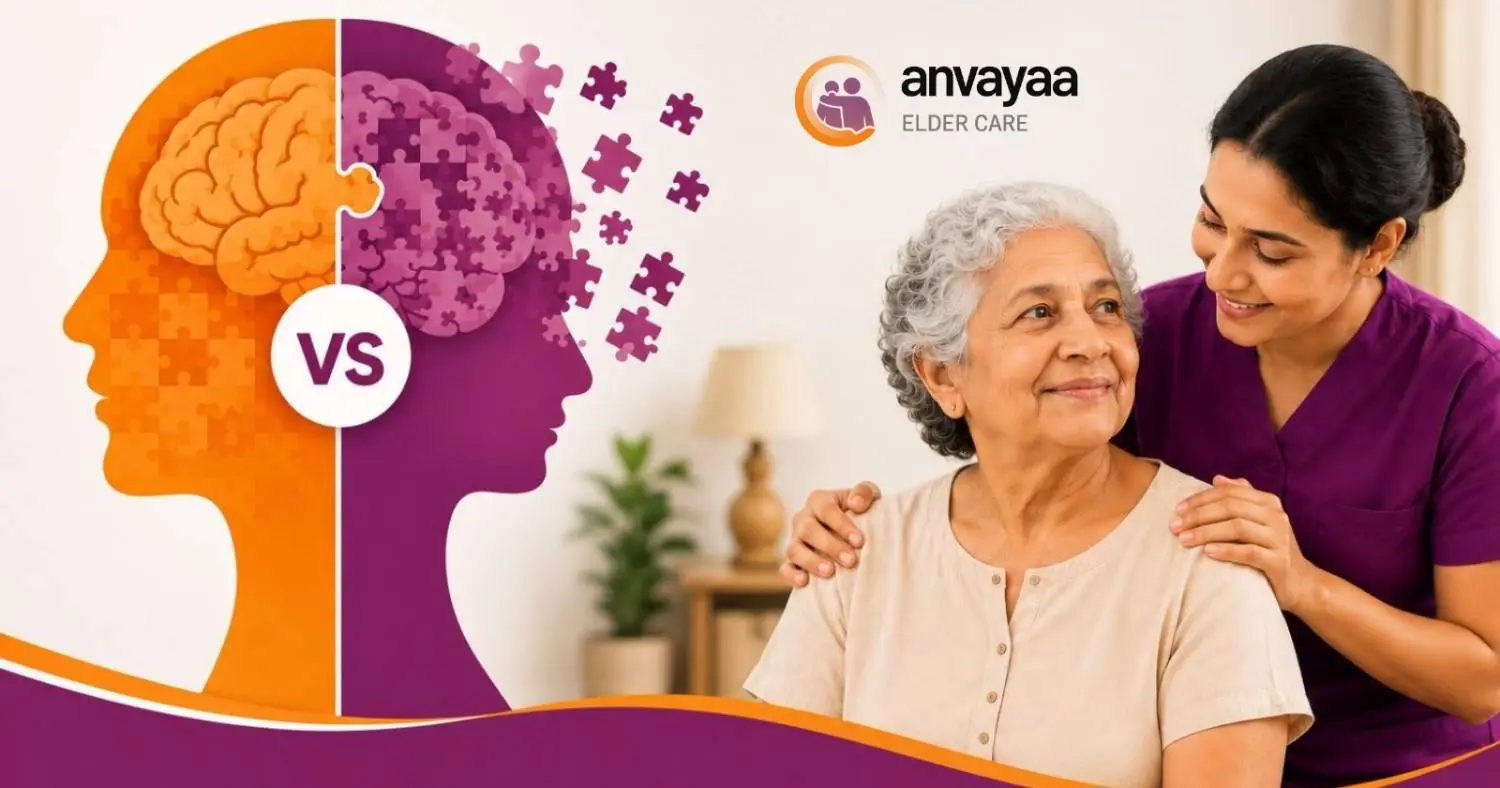
If you’ve ever heard someone use “Alzheimer’s” and “dementia” interchangeably, you’re not alone — it’s one of the most common mix-ups in conversations about ageing and brain health. Many families, when a loved one starts forgetting names or repeating questions, immediately assume “it’s Alzheimer’s.” But the truth is a little more nuanced, and understanding the difference matters — not just for medical accuracy, but for how families plan care, set expectations, and seek the right kind of support.
In this blog, we’ll clear up the confusion around Alzheimer’s and dementia, walk through the early signs every family should watch for, bust some common myths, and explain how Anvayaa helps families manage at home with care specialist for loved ones living with these conditions.
Alzheimer’s vs Dementia: What’s the Real Difference?
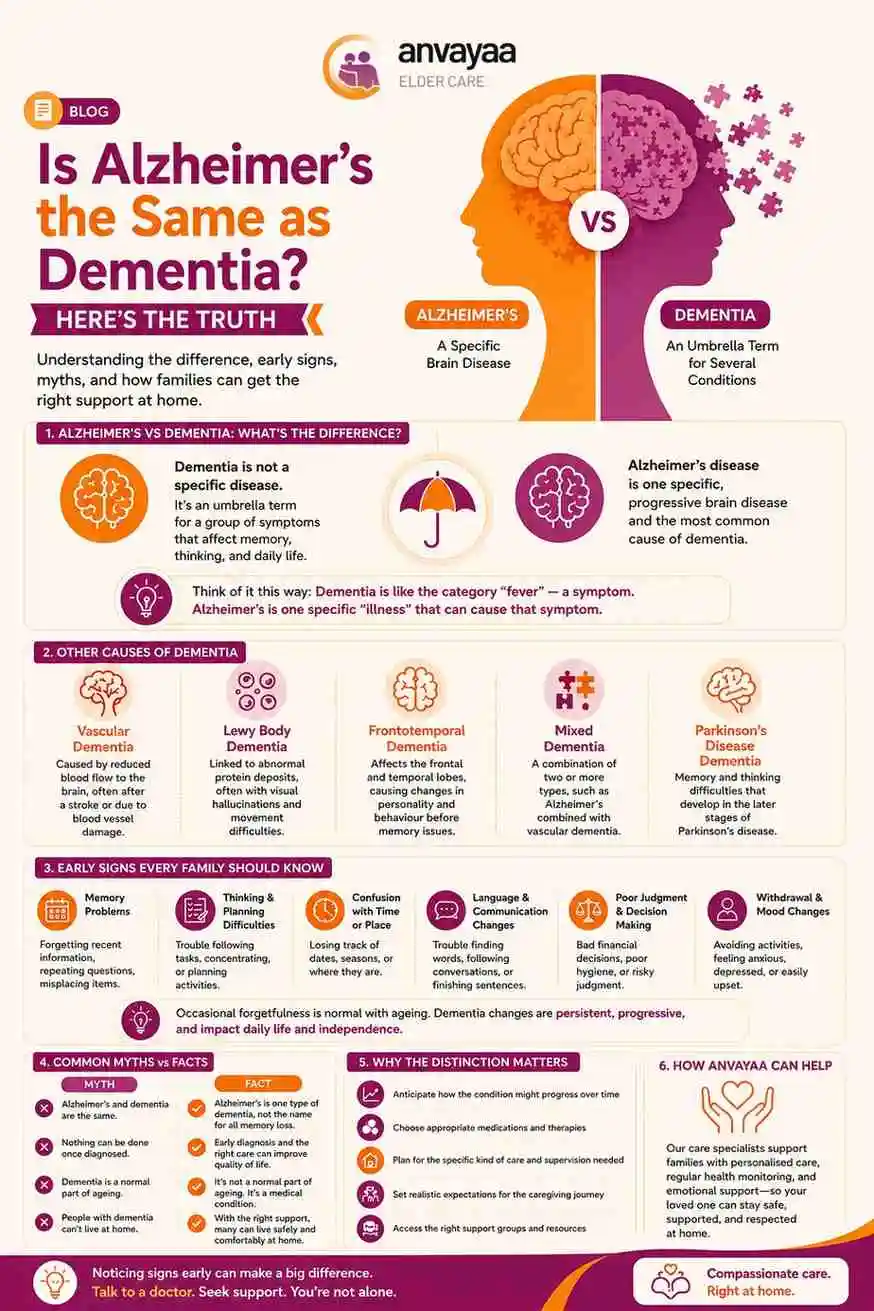
Let’s start with the most important clarification: dementia is not a specific disease. It’s an umbrella term used to describe a group of symptoms — primarily a decline in memory, thinking, reasoning, and the ability to perform everyday activities — that is severe enough to interfere with daily life.
Alzheimer’s disease, on the other hand, is one specific, progressive brain disease, and it happens to be the most common cause of dementia, accounting for a large majority of cases worldwide.
Think of it this way: dementia is like the category “fever” — a symptom that can be caused by many different underlying illnesses. Alzheimer’s is one specific “illness” that causes that symptom, much like the flu might be one cause of a fever among several possible causes.
Other Causes of Dementia
While Alzheimer’s is the leading cause, it isn’t the only one. Other conditions that fall under the dementia umbrella include:
- Vascular dementia — caused by reduced blood flow to the brain, often following a stroke or due to long-term blood vessel damage
- Lewy body dementia — associated with abnormal protein deposits in the brain, often accompanied by visual hallucinations and movement difficulties
- Frontotemporal dementia — affects the frontal and temporal lobes of the brain, often causing changes in personality and behaviour before memory issues appear
- Mixed dementia — a combination of two or more types occurring simultaneously, such as Alzheimer’s combined with vascular dementia
- Parkinson’s disease dementia — memory and thinking difficulties that develop in the later stages of Parkinson’s disease
Each of these has its own underlying cause, pattern of progression, and in some cases, different treatment approaches — which is exactly why getting an accurate diagnosis matters so much.
Why the Distinction Matters
Understanding whether a loved one has Alzheimer’s specifically, or another form of dementia, helps families and doctors:
- Anticipate how the condition might progress over time
- Choose appropriate medications and therapies
- Plan for the specific kind of care and supervision that will likely be needed
- Set realistic expectations for the family’s caregiving journey
- Access the right support groups and resources, many of which are condition-specific
A vague label of “memory problems” or assuming every case is Alzheimer’s can lead to delayed or inappropriate care decisions.
Early Signs of Dementia Every Family Should Know
Recognizing dementia early — regardless of its underlying cause — can make a significant difference in how a family responds, plans, and accesses support. Here are the early signs worth paying attention to.
Memory-Related Signs
- Forgetting recently learned information, especially repeating the same questions
- Misplacing items frequently and being unable to retrace steps to find them
- Forgetting important dates or events, and increasingly relying on memory aids or family members for things they used to handle on their own
Thinking and Planning Difficulties
- Trouble following a familiar recipe or keeping track of monthly bills
- Difficulty concentrating, and taking much longer to do things that used to come easily
- Struggling to plan or organize multi-step tasks
Confusion with Time or Place
- Losing track of dates, seasons, or the passage of time
- Forgetting where they are or how they got there
- Sometimes forgetting the purpose of being in a familiar place
Language and Communication Changes
- Trouble following or joining a conversation
- Stopping mid-sentence with no idea how to continue
- Struggling to find the right word, or substituting unusual words for familiar objects
Changes in Judgment and Decision-Making
- Giving away large amounts of money to telemarketers or unfamiliar callers
- Paying less attention to grooming or personal hygiene
- Poor judgment when dealing with money or in social situations
Withdrawal and Mood Changes
- Avoiding social activities, hobbies, or work projects they used to enjoy
- Becoming increasingly confused, suspicious, depressed, fearful, or anxious
- Getting easily upset in unfamiliar settings or when their normal routine is disrupted
Misplacing Things and Losing the Ability to Retrace Steps
This goes beyond ordinary forgetfulness — it might mean putting things in unusual places, like keeping the television remote in the refrigerator, and being unable to retrace their steps to find lost items.
It’s worth emphasizing: occasional forgetfulness is a normal part of ageing. The difference with dementia is that these changes are persistent, progressive, and significant enough to disrupt daily life and independence. If a family notices several of these signs occurring regularly, it’s worth consulting a doctor for a proper evaluation rather than assuming the worst — or dismissing it entirely.
Alzheimer’s vs Dementia: Common Myths and Facts
Misinformation around Alzheimer’s and dementia is widespread, and it often leads to delayed diagnoses, unnecessary stigma, and poor care decisions. Let’s separate myth from fact.
Myth: Alzheimer’s and dementia are the same thing.
Fact: As covered above, dementia is an umbrella term for a set of symptoms, and Alzheimer’s is one specific disease that is the most common cause of those symptoms.
Myth: Dementia is just a normal part of ageing.
Fact: While the risk of dementia increases with age, it is not a normal or inevitable part of growing older. Many people live well into their nineties with sharp memory and cognitive function. Dementia results from specific diseases that damage brain cells.
Myth: Only elderly people get Alzheimer’s or dementia.
Fact: While the majority of cases occur in people over 65, younger-onset Alzheimer’s and dementia can affect people in their 40s, 50s, and early 60s, though this is less common.
Myth: If a parent has Alzheimer’s, their children will definitely get it too.
Fact: Having a parent with Alzheimer’s does increase risk somewhat, but it does not guarantee that children will develop the condition. Genetics play a role, but lifestyle, environment, and other health factors are also significant contributors.
Myth: There’s nothing you can do once someone is diagnosed.
Fact: While there is currently no cure for Alzheimer’s or most forms of dementia, there are treatments, therapies, and care strategies that can help manage symptoms, slow progression in some cases, and meaningfully improve quality of life for both the patient and the family.
Myth: People with dementia can’t understand or communicate at all.
Fact: Especially in the early and middle stages, people with dementia can often understand much more than they’re given credit for, and continue to communicate, express preferences, and connect emotionally with loved ones, even as verbal communication becomes more challenging over time.
Myth: Memory loss is the only symptom that matters.
Fact: Dementia affects much more than memory — it can impact judgment, mood, personality, language, spatial awareness, and the ability to carry out everyday tasks. Some types of dementia, like frontotemporal dementia, may show personality and behavioral changes before memory issues even appear.
Myth: Caregiving for someone with dementia is mainly about managing forgetfulness.
Fact: Dementia caregiving often involves managing a wide range of challenges, including mood swings, disorientation, wandering, sleep disturbances, difficulty with daily activities like bathing and eating, and significant emotional strain for both the patient and the family.
Myth: A dementia diagnosis means moving to a care facility right away.
Fact: Many people with early and even moderate-stage dementia can continue living safely and comfortably at home with the right support system in place, including home nursing care, supervision, and a structured daily routine.
Supporting a Loved One with Alzheimer’s or Dementia at Home
For many families, the preference is clear: keep their loved one at home, in familiar surroundings, for as long as it’s safe and feasible to do so. Familiarity is genuinely beneficial for people with dementia — recognizable spaces, routines, and faces can reduce confusion, agitation, and anxiety, all of which tend to worsen in unfamiliar environments like hospitals or unfamiliar care facilities.
That said, caring for someone with Alzheimer’s or dementia at home is demanding. It often requires:
- Constant supervision to prevent wandering or accidents
- Patience and specific communication techniques suited to cognitive decline
- Assistance with daily activities like bathing, dressing, and eating
- Managing medications and coordinating with doctors
- Emotional support — for both the patient and the family members providing care
- Creating a safe, structured home environment that minimizes confusion and risk
This is often more than family members alone can sustainably manage, especially if they’re also working, raising children, or living in a different city from their ageing parent.
How Anvayaa Helps with Care Specialist for Alzheimer’s and Dementia
This is exactly where Anvayaa steps in — helping families provide professional, compassionate care for loved ones with Alzheimer’s or dementia, right in the comfort of home.
Trained Care specialist experienced with cognitive conditions. Anvayaa connects families with care specialist and nursing staff who understand the specific needs of patients living with memory and cognitive disorders, including how to communicate patiently, manage confusion, and respond to behavioural changes with empathy rather than frustration.
Personalized care plans. Every dementia journey looks different. Anvayaa works with families to build a care plan suited to the specific stage and type of dementia, whether that means light supervision and companionship in the early stages or more comprehensive support with daily living tasks as the condition progresses.
Safety and supervision at home. Wandering, confusion, and accidents are common concerns for families caring for someone with dementia. Anvayaa’s caregivers provide the consistent supervision needed to keep loved ones safe while preserving as much of their independence and dignity as possible.
Support with daily routines. From medication reminders to assistance with bathing, dressing, and meals, Anvayaa’s home nursing services help maintain the structure and routine that’s so important for people living with cognitive decline.
Coordination with doctors and specialists. Anvayaa helps families stay connected with neurologists, geriatricians, and other specialists, ensuring that care at home remains aligned with medical guidance and that any changes in condition are communicated and addressed promptly.
Emotional support for the whole family. Caring for a loved one with Alzheimer’s or dementia takes a toll not just physically but emotionally. Anvayaa’s approach considers the wellbeing of family caregivers too, offering reassurance, regular updates, and a reliable support system so families don’t have to navigate this journey alone.
Flexibility as needs change. Dementia is progressive, and care needs evolve over time. Anvayaa’s services are designed to adapt, scaling up support as required, rather than forcing families into a one-size-fits-all care model.
By bringing trained, compassionate care into the home, Anvayaa helps families give their loved ones living with Alzheimer’s or dementia the dignity, safety, and familiarity that makes such a meaningful difference in their quality of life.
Final Thoughts
Alzheimer’s and dementia are related but not identical — dementia is the broader umbrella term, and Alzheimer’s is its most common specific cause. Recognizing early signs, understanding the facts over the myths, and seeking timely medical guidance can help families respond with clarity instead of fear. And when it comes to ongoing care — like what Anvayaa offers — can make it possible for loved ones to stay in familiar, comforting surroundings while still receiving the professional care and supervision they need. With the right information and the right support system, families can face this journey with more confidence and far less uncertainty.

0 Comments